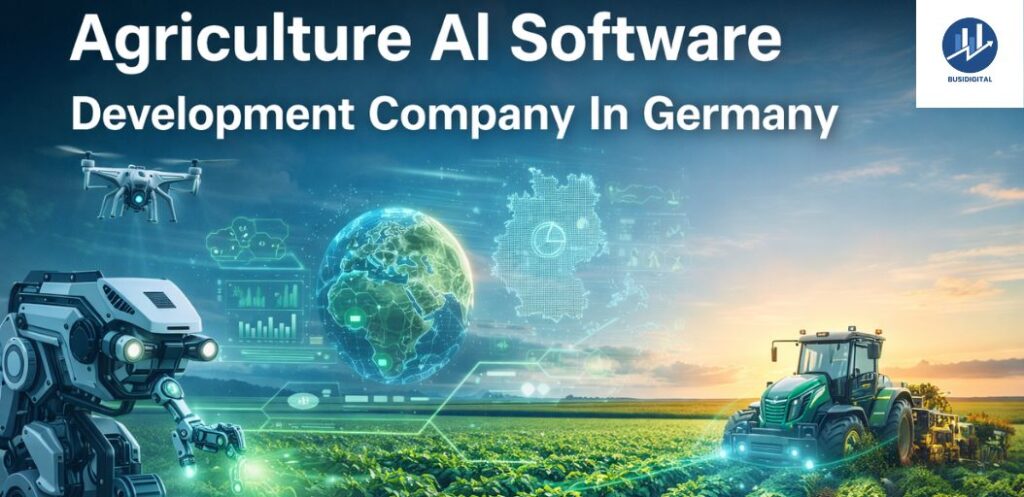
Germany is one of Europe’s strongest agricultural economies, known for precision farming, advanced machinery, and sustainable practices. With rising labor shortages, climate change challenges, and increasing demand for higher yields, farmers and agribusinesses are turning to AI-powered solutions to stay competitive.
If you are looking for an Agriculture AI Software Development Company in Germany, this detailed guide will help you understand how AI is transforming farming and why investing in intelligent agricultural software is the future.
The Current State of Agriculture in Germany
Agriculture in Germany is highly mechanized and technology-driven. From Bavaria’s dairy farms to Lower Saxony’s crop fields, farmers rely on efficiency and sustainability. However, the industry faces:
- Climate unpredictability
- Rising operational costs
- Shortage of skilled labor
- Strict EU sustainability regulations
- Increasing competition
This is where AI-powered agriculture software plays a critical role.
What is Agriculture AI Software?
Agriculture AI software uses technologies like:
- Artificial Intelligence (AI)
- Machine Learning (ML)
- Computer Vision
- IoT Integration
- Predictive Analytics
- Drone Data Processing
These systems analyze farm data to provide actionable insights for:
- Crop health monitoring
- Yield prediction
- Soil quality analysis
- Pest detection
- Automated irrigation
- Livestock monitoring
Why Germany Needs AI in Agriculture
Germany is home to global agricultural technology leaders like Bayer and BASF, which are already investing heavily in digital farming.
Additionally, research institutions such as Fraunhofer Society are advancing smart agriculture innovations.
Key reasons AI adoption is accelerating in Germany:
Precision Farming Demand
Farmers require real-time insights to optimize fertilizer, water, and pesticide usage.
Sustainability & EU Regulations
AI helps reduce environmental impact and ensures compliance with EU farming policies.
Labor Shortage
Automation reduces dependency on manual farm labor.
Climate Change Adaptation
AI models predict weather impact and optimize planting cycles.
Read Also: AI OTT App Development in Germany: Building the Future of Smart Streaming Platforms
Core AI Solutions for Agriculture in Germany
A professional Agriculture AI Software Development Company in Germany offers:
AI-Based Crop Monitoring Systems
- Drone & satellite image analysis
- Disease detection via computer vision
- Nutrient deficiency prediction
Smart Irrigation Management
- Soil moisture AI sensors
- Automated water scheduling
- Weather-based optimization
Predictive Yield Analytics
- Historical crop data analysis
- Market demand forecasting
- Risk modeling
Livestock Monitoring Software
- Health tracking using wearable sensors
- Automated feeding optimization
- Behavioral analytics
AI-Powered Farm Management Platforms
- Centralized dashboards
- IoT integration
- Real-time performance metrics
Technologies Used in Agriculture AI Software Development
Top companies in Germany use:
- Python, TensorFlow, PyTorch
- Computer Vision APIs
- Cloud Platforms (AWS, Azure, GCP)
- IoT Sensor Integration
- Big Data Analytics
- GIS & Geospatial Mapping
Integration with smart machinery from companies like CLAAS enhances operational automation.
Benefits of Hiring an Agriculture AI Software Development Company in Germany
Increased Crop Yield
AI-driven decisions improve production efficiency.
Reduced Operational Costs
Optimized fertilizer, water, and pesticide usage.
Better Decision-Making
Real-time dashboards provide accurate insights.
Improved Sustainability
Reduced carbon footprint and chemical usage.
Competitive Advantage
Stay ahead in Germany’s advanced farming market.
Custom Agriculture AI Software Development Process
A professional development company typically follows:
Step 1: Requirement Analysis
Understanding farm size, crop type, and data availability.
Step 2: Data Collection & Integration
IoT devices, drone feeds, weather APIs, and historical data.
Step 3: AI Model Development
Custom ML models for prediction and automation.
Step 4: Testing & Optimization
Field testing and model accuracy improvement.
Step 5: Deployment & Support
Cloud deployment and continuous monitoring.
AI Use Cases in German Agriculture
Smart Greenhouses
AI regulates temperature, humidity, and lighting automatically.
Vineyard Monitoring
Disease detection in grapes using computer vision.
Dairy Farm Automation
Milk production optimization and health monitoring.
Organic Farming Analytics
Chemical-free pest detection solutions.
Why Choose a German-Based Agriculture AI Software Company?
Choosing a Germany-based company ensures:
- GDPR compliance
- Understanding of EU agricultural policies
- Local language support
- On-site consultation
- Faster response times
Germany’s strong digital infrastructure and innovation ecosystem make it an ideal location for advanced AgriTech development.
The Future of Agriculture AI in Germany
The future is driven by:
Autonomous tractors
- AI-powered robotic harvesting
- Blockchain-enabled supply chain tracking
- Real-time satellite monitoring
- Fully automated smart farms
Government support and innovation grants further accelerate AI adoption in agriculture across Germany.
How to Select the Best Agriculture AI Software Development Company in Germany
When selecting a company, check:
- AI & ML expertise
- Agriculture domain experience
- Case studies & portfolio
- Data security practices
- Post-deployment support
- Scalability capabilities
Look for a company that offers end-to-end AI transformation, not just software coding.
Conclusion
Agriculture in Germany is entering a new digital era. With climate challenges, regulatory pressures, and increasing demand for efficiency, AI-powered agriculture software is no longer optional—it’s essential.
An experienced Agriculture AI Software Development Company in Germany can help farmers, agribusinesses, and agricultural enterprises leverage data, automation, and intelligence to maximize yield and profitability.
Investing in AI-driven agriculture today ensures sustainable, profitable, and future-ready farming operations in Germany.