
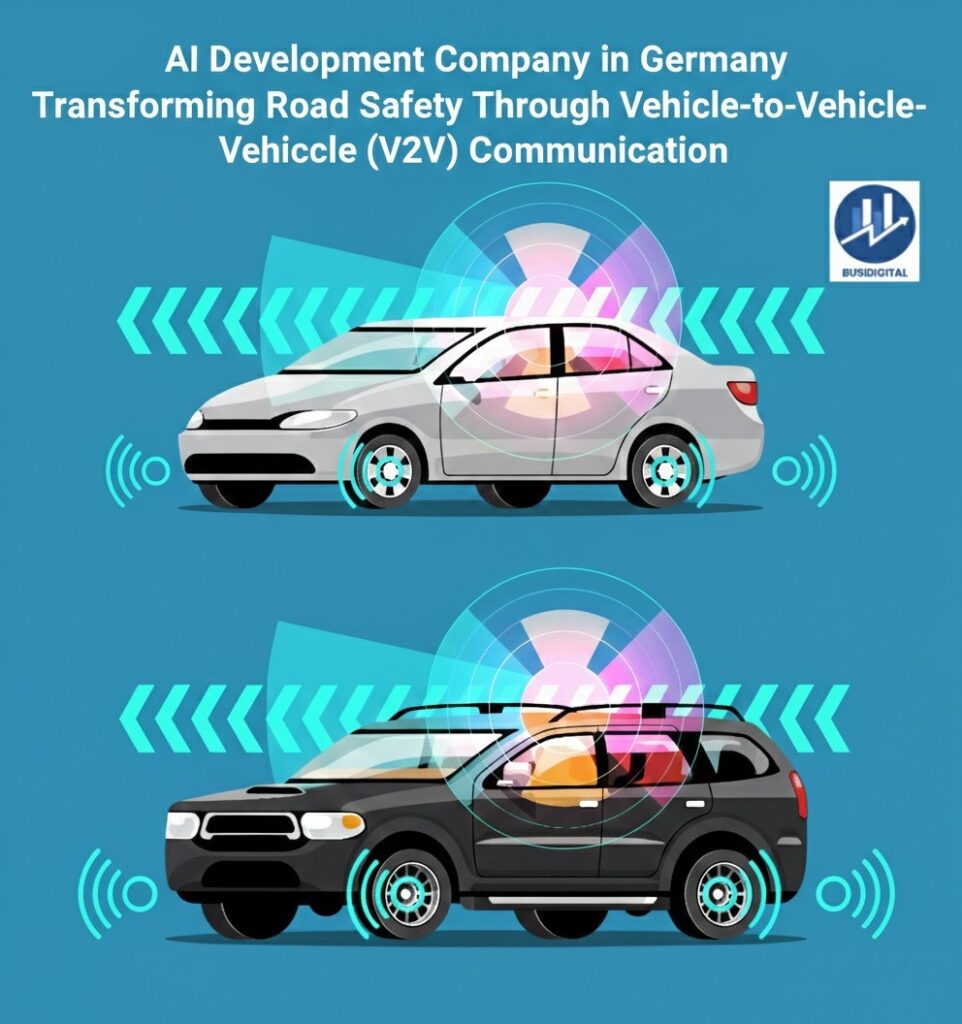
Germany has long been recognized as a global leader in automotive engineering, innovation, and transportation infrastructure. With the rapid advancement of Artificial Intelligence (AI), connected vehicles, and smart mobility solutions, the country is now entering a new era of intelligent transportation. One of the most transformative technologies driving this shift is Vehicle-to-Vehicle (V2V) communication, powered by advanced AI systems.
As road networks become increasingly complex and traffic volumes continue to grow across German cities and highways, traditional safety systems alone are no longer sufficient. AI-enabled V2V communication is emerging as a critical solution capable of preventing accidents, improving traffic efficiency, and supporting autonomous driving ecosystems. Today, every forward-thinking AI Development Company in Germany is playing a vital role in building safer, smarter, and more connected transportation systems.
Read Also: AI Entwicklung Deutschland: KI Lösungen für Unternehmen | Busidigital
Understanding Vehicle-to-Vehicle (V2V) Communication
Vehicle-to-Vehicle communication refers to the wireless exchange of real-time data between vehicles on the road. Using technologies such as sensors, edge computing, and AI algorithms, vehicles can communicate important information including:
- Speed and acceleration
- Vehicle position and direction
- Sudden braking alerts
- Road hazards and collision risks
- Traffic congestion updates
- Weather and road conditions
Unlike traditional safety mechanisms that react after a driver takes action, V2V systems allow vehicles to predict potential dangers before they occur.
For example, if a vehicle suddenly brakes on a busy German Autobahn, nearby connected vehicles instantly receive warnings through V2V communication, allowing automated or assisted responses within milliseconds.
Why Germany is Leading the V2V Revolution
Germany provides the perfect environment for V2V adoption due to several factors:
Strong Automotive Ecosystem
Germany is home to globally recognized automotive manufacturers and mobility innovators investing heavily in connected vehicle technologies and autonomous driving systems.
Smart Infrastructure Development
German cities are rapidly adopting Intelligent Transport Systems (ITS) to manage urban mobility challenges efficiently.
Industry 4.0 Integration
The country’s Industry 4.0 initiatives promote AI, IoT, and automation integration across transportation and logistics networks.
Road Safety Prioritization
Reducing road accidents and improving traffic flow efficiency remains a national priority, making AI-powered transportation solutions highly relevant.
This ecosystem creates significant opportunities for AI development companies specializing in mobility and automotive intelligence.
The Role of AI in V2V Communication
Artificial Intelligence acts as the brain behind V2V communication systems. While vehicles exchange massive amounts of data every second, AI enables intelligent decision-making through:
Real-Time Data Processing
AI models analyze sensor and communication data instantly to detect risks such as collision probability or unsafe driving behavior.
Predictive Analytics
Machine learning algorithms predict future traffic conditions and accident risks based on historical and real-time data patterns.
Automated Decision Systems
AI allows vehicles to automatically adjust speed, braking, or lane positioning when danger is detected.
Edge AI Computing
Processing data directly within vehicles reduces latency, ensuring faster safety responses critical for high-speed road environments.
Without AI, V2V communication would simply be data exchange; with AI, it becomes an intelligent safety ecosystem.
How an AI Development Company in Germany Drives Road Safety Innovation
An experienced AI development company contributes to V2V transformation across multiple stages of intelligent mobility development.
AI Model Development for Connected Vehicles
AI engineers design machine learning models capable of interpreting vehicle data streams and predicting safety risks in real time.
Intelligent Traffic Management Systems
AI solutions integrate vehicle communication with city infrastructure, enabling traffic signal optimization and congestion reduction.
Autonomous Driving Enablement
V2V communication enhances autonomous vehicles by expanding environmental awareness beyond onboard sensors.
Edge Computing Integration
AI developers build low-latency architectures that process safety-critical data locally within vehicles.
Mobility Data Analytics Platforms
Advanced analytics dashboards help automotive companies monitor fleet performance, safety metrics, and traffic insights.
Key Benefits of AI-Powered V2V Communication
Accident Prevention
Vehicles can detect threats outside the driver’s visibility range, dramatically reducing collision risks.
Improved Traffic Flow
Real-time communication minimizes traffic jams through cooperative driving behavior.
Reduced Emissions
Optimized driving patterns reduce fuel consumption and environmental impact.
Support for Autonomous Vehicles
V2V communication enables safer decision-making for self-driving cars.
Fleet Optimization
Logistics and transportation companies benefit from predictive routing and operational efficiency.
Use Cases Across German Industries
Automotive Manufacturing
OEMs integrate AI-based V2V systems into next-generation connected vehicles.
Logistics & Freight Transportation
Fleet vehicles communicate road conditions to prevent delays and accidents.
Smart Cities
Urban mobility platforms use V2V data to improve traffic management.
Public Transportation
Buses and emergency vehicles gain priority routing through intelligent communication systems.
Insurance Technology
Real-time driving data enables usage-based insurance and risk assessment models.
Technologies Powering AI-Based V2V Systems
Modern V2V communication relies on a combination of advanced technologies:
- Artificial Intelligence & Machine Learning
- Internet of Things (IoT) Sensors
- 5G Connectivity
- Edge Computing
- Computer Vision
- Cloud-Based Mobility Platforms
- Cybersecurity Frameworks
- AI development companies in Germany combine these technologies to build scalable and secure transportation ecosystems.
Challenges in Implementing V2V Communication
Despite its advantages, deploying V2V systems presents challenges:
Data Security & Privacy
Vehicle communication networks must be protected from cyber threats.
Standardization
Ensuring compatibility across different manufacturers remains critical.
Infrastructure Readiness
Smart infrastructure deployment requires coordinated investment.
Real-Time Processing Requirements
Ultra-low latency systems demand advanced AI optimization.
AI development companies address these challenges through secure architectures, intelligent protocols, and scalable system design.
The Future of Road Safety in Germany
The future of transportation in Germany will be defined by connected intelligence rather than isolated vehicles. Emerging developments include:
- Cooperative Autonomous Driving
- Vehicle-to-Everything (V2X) Communication
- AI-Based Traffic Prediction
- Smart Highway Infrastructure
- Digital Twin Transportation Systems
As vehicles evolve into intelligent computing platforms, AI-driven communication will become essential for achieving near-zero accident environments.
Germany’s vision of smart mobility depends heavily on collaboration between automotive companies, technology providers, and AI development partners.
Why Businesses Partner with an AI Development Company in Germany
Organizations across Europe increasingly collaborate with AI specialists to accelerate mobility innovation. Key reasons include:
- Access to advanced AI expertise
- Faster product development cycles
- Scalable intelligent mobility solutions
- Compliance with European technology standards
- Reduced operational risks
AI partners help enterprises transition from traditional transportation models toward connected and autonomous ecosystems.
Business Opportunities for Automotive & Mobility Companies
V2V communication opens new revenue opportunities such as:
- Connected vehicle platforms
- Mobility-as-a-Service (MaaS) solutions
- Predictive maintenance systems
- Smart fleet management software
- AI-powered traffic analytics tools
Companies investing early in AI-enabled transportation technologies gain a competitive advantage in Europe’s rapidly evolving mobility market.
Conclusion
Vehicle-to-Vehicle communication represents one of the most significant breakthroughs in modern transportation safety. By enabling vehicles to communicate, predict risks, and respond intelligently, AI is transforming how roads operate across Germany.
An innovative AI Development Company in Germany plays a crucial role in this transformation by designing intelligent systems that integrate AI, connectivity, and automation into everyday mobility. From preventing accidents on high-speed highways to optimizing urban traffic systems, AI-powered V2V communication is shaping the future of safer and smarter transportation.
As Germany advances toward autonomous mobility and smart city infrastructure, organizations adopting AI-driven V2V solutions today will lead tomorrow’s connected transportation ecosystem.